
Marketing · 14 Nov 2026 · 6 min read
What we learned checking 14,500 Himachal businesses for a website
Walk down the Mall in Shimla, or through the market in Solan or Dharamshala, and you’ll pass dozens of businesses that do well without a website: homestays booked through platforms, cafes found on Google Maps, clinics that run on word of mouth. We build websites, so we wanted to know how many of them there really were, and whether we could reach them better than by scrolling a map and copying numbers into a spreadsheet.
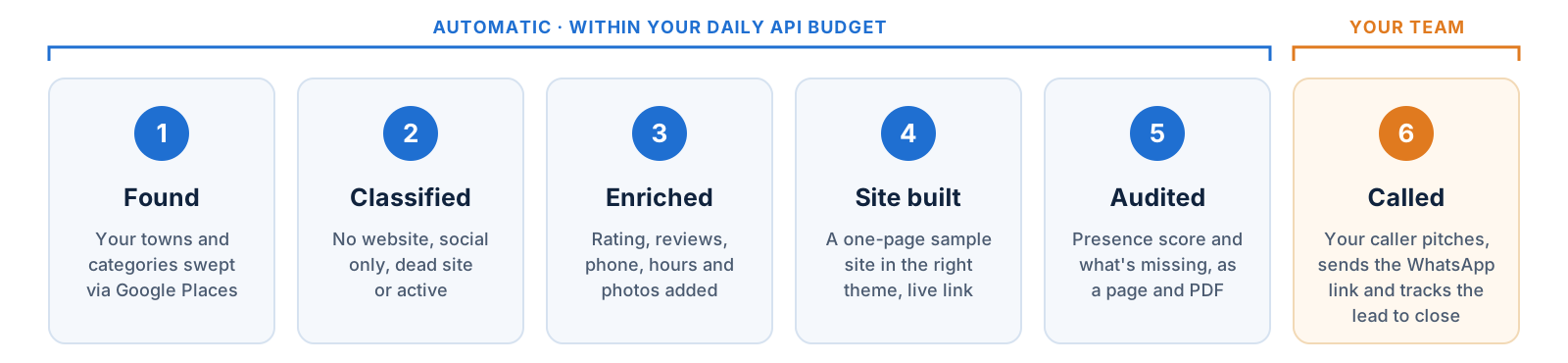
So we built a tool for our own sales team. Since 20 September 2026, NetGen LeadSweep has checked 14,593 businesses across 58 categories in more than 500 towns and localities in Himachal Pradesh. Here’s what it does, what went wrong, and what we learned.
The goal: a reason to call, not just a number
A list of phone numbers isn’t much use on its own. We wanted every lead to arrive with three things:
- Proof of the gap. Does this business really lack a website, or is its site just slow today?
- Something to show. A sample website for this business, built before anyone calls.
- A reason to call this one first. A well-reviewed hotel with no website should come before a new listing with three reviews.
Rule one: official data only
The fastest way to build a tool like this is to scrape Google Maps. We didn’t. Every listing comes from the official Google Places API, every photo keeps its attribution, and “Powered by Google” appears wherever we show listing data.
That choice costs money: the API is billed per call. So LeadSweep has daily and monthly call limits, searches with Google’s free ID-only search, and caches each listing for 30 days so we never pay twice for the same business.
The second rule: no automated messaging. LeadSweep writes a WhatsApp message with the sample site link, and a person reads it and presses send. Bulk messaging small business owners is a good way to annoy them and get your number blocked.
Finding one: most local businesses still have no working website
Of the 14,583 businesses we’ve classified so far:
| Web presence | Businesses | Share |
|---|---|---|
| No website at all | 8,735 | 60% |
| Dead website | 1,211 | 8% |
| Social media page only | 525 | 4% |
| Working website | 4,112 | 28% |
That’s 72% with no working website: well over seven in ten local businesses in our area are invisible to anyone who searches beyond Google Maps, and many of them have good ratings and hundreds of reviews.
Finding two: “has a website” is harder to answer than it sounds
Our first version asked a simple question: is the website field on the listing empty? Real data made it more complicated.
- Social pages aren’t websites. Many listings link to a Facebook or Instagram page, or a directory listing. We treat those as their own group: warm leads, not hot ones.
- Dead sites are common. Over 1,200 listings point to a domain that no longer resolves, returns an error or shows a parked page. To the owner, they have a website. To their customers, they don’t.
- Chains look like small businesses. National hotel chains and lab franchises list every branch separately, and their branch pages often fail our checks. For a while they showed up as hot leads. We now keep chain and franchise listings out with simple name, domain and phone rules.
- The same business is listed many times. Duplicate listings with the same phone or address are common. LeadSweep finds likely pairs and lets us merge them, and the merge sticks on the next sweep.
We also made a costly early mistake: we classified businesses from search results, which don’t include the website field. Every business looked like it had no website. Now classification waits until the full listing has been fetched. Lesson: check what your data source actually returns before you build on it.
Finding three: limits should pause work, not break it
Staying inside a daily API budget is easy in theory. In practice, when we hit the limit, hundreds of queued jobs kept retrying immediately and failed. Now a job that meets the limit simply waits for the next day, and a job health page shows anything that’s stuck.
Finding four: callers need a reason to call this business today
The first version gave callers a list sorted by date. Our callers asked for more, and most of LeadSweep’s features came from them.
- A priority score. Leads are ranked by rating, number of reviews and how big the website gap is.
- A call brief. A few lines at the top of each lead: “4.7 stars from 128 reviews and no website”, a review that mentions trouble booking or finding them, and how many nearby competitors already have a site.
- A commission calculator for hotels. For homestays, the strongest argument is what they pay booking platforms in commission each month. The calculator puts that into rupees, next to the cost of a website.
- Honest call outcomes. Many numbers simply don’t answer. Callers asked for “no answer” and “multiple attempts” stages, and nearly a thousand leads now sit in the multiple-attempts stage instead of cluttering the daily queue.
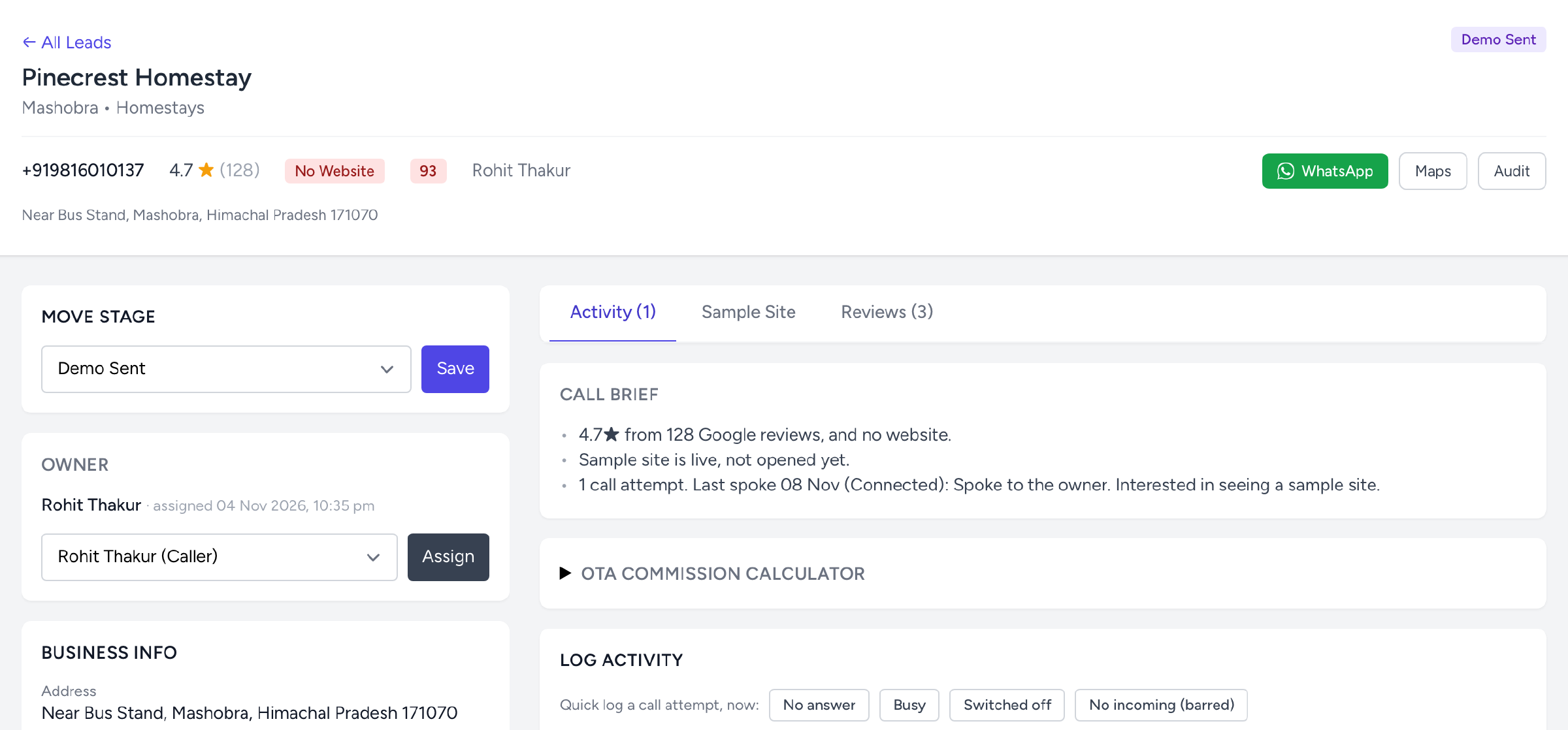
Our callers have logged 8,898 calls across 11,167 leads so far.
Finding five: show the owner their own website
“We’ll build you a website” is easy to turn down. “Here’s your website, have a look” starts a different conversation.
For each lead our team is working, LeadSweep builds a one-page site from the listing: name, rating, reviews, rooms or services, map, opening hours and a WhatsApp button as the main call to action. An AI model writes the copy from the listing’s facts and the business’s own reviews, with strict rules against inventing anything. Each category has one layout and several themes, so a heritage hotel and a modern cafe don’t look the same.
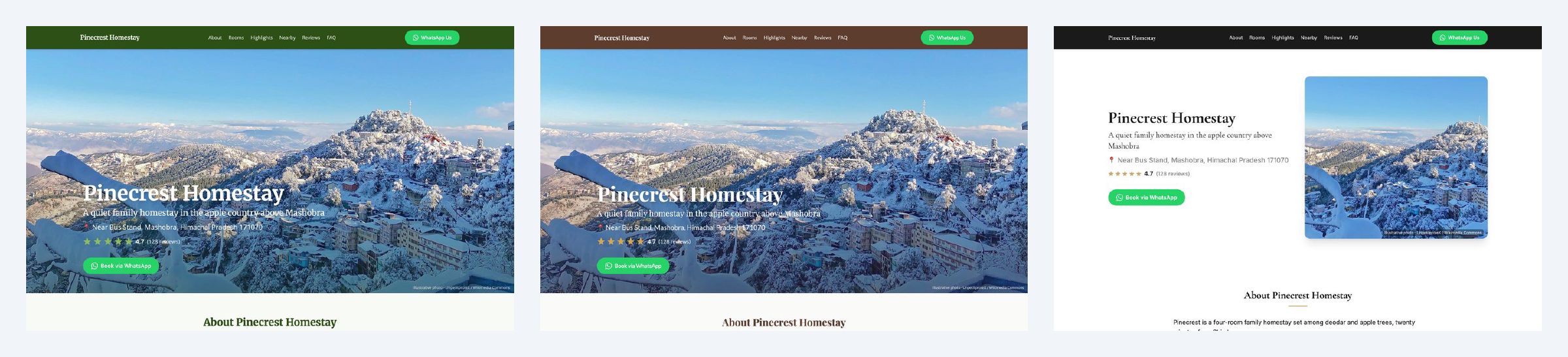
We’ve built 299 sample sites so far. We build them for leads our team is actively working, not for every business in the database: a sample site only helps if someone is about to call. LeadSweep also records when a site is opened, so a caller can phone while the owner is still looking at it.
Each lead also gets a web-presence audit: a score out of 100, a plain list of what’s missing, and a QR code to the sample site. It gives the owner something to look at after the call.
What we’d tell another team
- Use official data and stay inside its rules. It costs a little more and never comes back to bite you.
- Don’t trust a single field. Check that websites actually work, and expect social pages, dead domains, chains and duplicates.
- Rank leads. A caller’s time is the scarcest resource you have.
- Show, don’t tell. A sample site does more in one message than a five-minute pitch.
- Keep a person in the loop. Automate the research, not the conversation.
We built LeadSweep for our own team, and we now offer it to other web agencies and sales teams. If you sell websites or digital services to local businesses, see what NetGen LeadSweep can do for your team.